
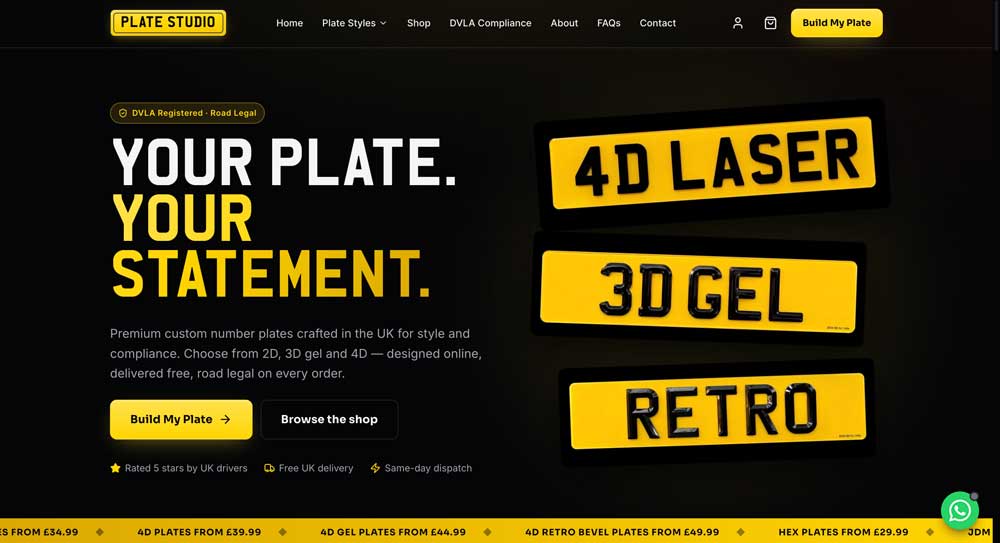
Plate Studio – Bringing a Complex, Regulated Purchase Online
Plate Studio needed to bring a complicated, compliance-heavy purchase online without sacrificing either the customer experience or the security of sensitive customer information. I designed and built one platform that does both: a live plate builder that shows customers exactly what they are buying, connected to a secure document and verification workflow that lets the business legally fulfil every order.
Jump to a section
Built with
- Next.js
- React
- TypeScript
- Tailwind CSS
- Node.js
- MongoDB
- Mongoose
- AWS S3
- Stripe
- PayPal
- Sharp
- Nodemailer
- reCAPTCHA
At a glance
Client
Plate Studio, a UK manufacturer of custom, road-legal number plates
The challenge
sell a highly configurable, legally regulated product online, including the identity checks the law requires before a plate can be made
What I built
a live visual plate builder, a full online shop and a secure document and review workflow, all running as one bespoke platform
My role
consultancy, solution design, development, hosting and ongoing support
The brief: two problems, not one
When Plate Studio first came to me, the conversation was about what their customers would see. Behind that sat a second requirement that mattered just as much to the business.
1. Helping customers see exactly what they are buying
A custom number plate is not an off-the-shelf product. The customer chooses their registration, the size and shape of the plate, the lettering style, the side badge, the border, the fixings and whether they want a front plate, a rear plate or a pair. Not every combination can actually be made.
Plate Studio wanted customers to design their plate on screen and see what the finished product would look like before ordering. They shared competitor sites and existing plate builders as examples of the experience they had in mind.
The goal was not to copy another builder. It was to turn a complicated physical product into something a customer could configure confidently and buy in a few minutes.
2. Handling sensitive documents properly
Plate Studio is a DVLA Registered Number Plate Supplier. Under the Road Vehicles (Display of Registration Marks) Regulations 2001, it must check a customer's identity and their right to use a registration before making a road-legal plate. That means collecting documents such as driving licences, passports and V5C log books.
These documents carry exactly the kind of personal information that should never sit in an inbox or in a public uploads folder. The business needed a way for customers to submit them, for the files to be stored securely with GDPR and data location in mind, and for authorised staff to review and verify them before the order goes into production.
This was not a side feature. Without it, the shop could take money for orders the business was not yet allowed to fulfil.
From a visual brief to a business application
Plate Studio needed to bring a complicated, compliance-heavy purchase online without sacrificing either the customer experience or the security of sensitive customer information.
The examples Plate Studio shared showed clearly what they wanted their customers to see. My job was to work through what the business needed behind that experience: how an order moves from the website to the workshop, what has to be checked, who checks it, and what happens when a document is missing.
Working through that together, the project grew from a plate configurator into a complete business application. The customer-facing shop and the behind-the-scenes compliance process became one system rather than two separate jobs.
One platform, two connected journeys
The customer journey
The customer types their registration and sees it on a realistic plate straight away. As they change the size, lettering, badge, border and fixings, the preview and the price update instantly. Options that cannot be made simply aren't offered. When they're happy, they add the plate to the basket and pay by card or PayPal.
The fulfilment journey
Once an order is placed, the customer uploads proof of identity and entitlement against that specific order from their account. The files go into private storage. The team is notified, opens the order, reviews the documents, and marks each one as verified. Their name and the time are recorded against it. The customer can see in their account when each document has been verified.
Where the two meet
The two journeys are deliberately joined up so the paperwork cannot become an afterthought:
A first-time customer doesn't have to register before buying. At checkout the platform quietly creates their account and signs them in, specifically so they can upload their documents immediately.
The order confirmation email explains what documents are needed and links straight to the upload page for that order.
Every upload sends the customer a receipt and alerts the Plate Studio team.
If documents are missing, staff can send a reminder from the order screen with one click.
On the order screen, staff see the items, payment, documents and verification status side by side.
What the platform does
Each capability below starts with what it means for the business. The engineering behind it follows.
Visual product configuration
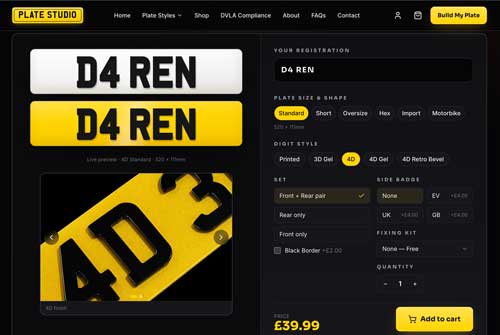
For the business: customers see their own registration on their chosen plate before they buy. The finished product matches what they approved on screen, so there are fewer surprises, fewer questions and more confident upgrades to premium finishes.
Under the hood:
The plate is rendered in the browser, not built from photos, so there is no library of thousands of pre-made images to maintain and no waiting for a server to draw one.
Character sizes, spacing and margins are calculated from real millimetre measurements, using CSS container query units. The preview stays to scale at any screen size, so a 340mm short plate really does look shorter than a 520mm standard plate.
Each lettering finish is drawn visually: printed, 3D gel, 4D acrylic, 4D gel and 4D retro bevel. Customers can see what an upgrade gives them instead of comparing product names.
Standard, short, oversize, hex, import/JDM and motorcycle formats are all supported. Import and motorcycle plates split the registration over two lines, and GB, UK and EV side bands are drawn when chosen.
Real product photography sits alongside the live preview: the builder shows the customer's plate; the photography shows the physical finish.
Manufacturing rules built in
For the business: customers can't order something the workshop can't make. Fewer orders need a follow-up call to explain that a combination isn't possible.
Under the hood: one product catalogue holds each plate's real dimensions, how many characters it can fit, and which finishes and extras it supports. The builder uses those rules as the customer clicks:
Motorcycle and oversize plates are rear-only, so the front/pair choice is removed.
Finishes that aren't made in a given size, such as retro bevel on import and motorcycle plates, are hidden.
Side badges are offered only on standard plates, and borders aren't offered on hex plates, which have their own edge.
Five- and six-digit short plates check the registration length and flag a registration that won't fit rather than quietly cutting it short.
The server applies the same rules again when the order arrives, so a request edited in the browser can't get round them.
Intelligent pricing
For the business: the price is always right, however the customer configures the plate. Nobody can change what they pay by tampering with the page.
Under the hood:
Plate Studio's price sheet is built into the pricing engine. Each price depends on the lettering style, the size group and whether the order is a pair or a single plate, with set prices for badges, borders, fixing kits and express delivery.
The customer sees the price update live as they build.
The browser's price is never trusted. When an order is created, the server recalculates every line from the plate's configuration, and the payment step refuses to charge if the stored total doesn't match a fresh calculation.
Secure document handling
For the business: customers' identity documents are never in public website storage or an email inbox. Only Plate Studio staff can open the original files, and the business can explain exactly how they are protected.
Under the hood:
Private cloud storage. Documents are stored in a private Amazon S3 bucket in a European AWS region, encrypted at rest. They are kept separate from the web server, so the website can be rebuilt or moved without moving anyone's identity documents with it.
No public links. Files have no public address. Every request goes through the application, which checks who is signed in and whether they are allowed to see that file before anything is returned.
Originals are for staff only. Only Plate Studio administrators can open or download the full-resolution original, and it is sent with headers that stop browsers and proxies keeping a copy.
Customers see a preview, not their passport. When a document is uploaded, the platform creates a small, low-resolution preview so customers can confirm they sent the right file. The original is never sent back to their browser.
Upload checks. Uploads are only accepted from a signed-in customer against an order they own. Files must be under a size limit and in an accepted format: PDF, JPG, PNG, WebP or HEIC.
Unguessable storage names. Every file gets a random storage key generated by the platform, so one file's location gives no clue to another's.
Least-privilege access. The website's AWS credentials can only read and write documents. They cannot change the bucket's own settings.
Safe development. On a developer's machine, the same code stores files in a private local folder instead, so production credentials and real customer documents are never needed to work on the site.
A review and verification workflow
For the business: the legal check becomes part of the order rather than a separate manual process. Every document has a clear record of when it arrived, who verified it and when, and the paperwork stays attached to the order.
Under the hood:
Each document is tagged as a V5C, ID, insurance or other document, and stored with its file details and the order it belongs to. The database holds the record; the file itself lives in private storage.
Staff mark each document as verified or unverified from the order or customer screen. The platform records the staff member and the time, creating an audit trail.
Orders move through clear stages: enquiry, pending, confirmed, paid, processing, dispatched, completed or cancelled. Staff control each step, with the document status in front of them.
The customer sees each document's status in their account as it changes.
Payments that don't lose orders
For the business: customers can pay by card or PayPal, and a successful payment always becomes a confirmed order, even if the customer closes the tab at the wrong moment.
Under the hood: the platform creates a pending order before asking for payment. Card payments use Stripe, whose signed webhook confirms each payment, and the success page double-checks the payment with Stripe independently. PayPal payments are confirmed on the server when the payment is captured, which also checks that the captured amount matches the order. Confirmation is safe to run more than once, so a payment is never recorded twice. Customers who send an enquiry instead of paying can pay for that order later from their account.
Customer accounts without the friction
For the business: nobody is forced to register before buying, but every customer ends up with an account where they can upload documents and track their order.
Under the hood: customers can see their current and previous orders, order status and documents, and update their contact and delivery details and reset their password. If someone checks out with an email address that already has an account, the order is added to that account but the shopper is not signed in automatically. Anyone who knew another customer's email address could otherwise get into their account.
A back office the business runs itself
For the business: day-to-day changes don't need a developer.
Under the hood: the admin area covers orders, customers, document review, password resets, product photography and shop copy, payment settings, delivery information and email. Customer emails use templates the team can edit, and each automatic email can be switched on or off: order confirmation, document received, document reminder and password reset. Product photography is managed separately from customer documents and follows completely different access rules.
Built for phones
For the business: most customers will configure their plate on a phone, and the experience works properly there.
Under the hood: the mobile builder follows the order customers actually decide in: Registration → Preview → Size → Style → Options → Final preview → Price. The live preview appears again at the points where a change matters, so the impact of each choice is always visible.
Found in search
For the business: the site can rank for each plate style and question customers search for, not just a single builder page.
Under the hood: the site has dedicated pages for each plate style, products, DVLA compliance, FAQs and policies. Every page has its own search metadata. Structured data describes the business, its services, products and FAQs, and an XML sitemap lists the site's pages.
What was delivered
A complex, configurable product can be bought online, end to end.
Customers see exactly what they are buying before they order.
Pricing is automatic, and the server makes sure it is right.
Orders that can't be made can't be placed.
The documents the law requires are collected as part of the customer's journey, not chased by email afterwards.
Sensitive documents are handled in a controlled way: private, encrypted, and opened only by staff.
Staff can review and verify documents in the admin area, with a record of who checked what and when.
The online shop and the fulfilment process are connected, so every order and its paperwork live in one place.
Not just number plates
Most businesses don't sell number plates. Many have the same underlying problem: a product, a process or a legal requirement that is too complicated for an off-the-shelf website.
The patterns in Plate Studio carry over directly:
Product configurators: let customers design something visually and see it before they buy.
Quote builders and rules-based pricing: calculate a correct price from many options and keep the business in control of it.
Eligibility checks: stop people ordering what can't be supplied or what they aren't entitled to.
Secure document submission: collect IDs, certificates or contracts without email attachments.
Compliance workflows: build the checks your industry requires into the order, with an audit trail.
Customer portals: give customers one place to track orders, upload information and pay outstanding balances.
Internal administration: give your team the screens they need to run the process without a developer.
Multi-stage purchases and bespoke ecommerce: sell things that need more than "add to basket, pay".
Booking systems and business automation: replace manual follow-ups with notifications, reminders and clear status.
If your business has a complicated product, workflow, compliance requirement or manual process, I can work through it with you and build software around how you actually operate.
Technical stack
For readers interested in the technology:
Next.js 16 (App Router), React 19, TypeScript, Tailwind CSS 4 with CSS container queries, Node.js, MongoDB with Mongoose, Amazon S3 (private, encrypted at rest), Sharp for image processing, Stripe (with signed webhooks), PayPal, Nodemailer with admin-editable templates, and Google reCAPTCHA v3.
Project Links
Let's Work Together
Ready to Build Something Remarkable?
Whether you need a bespoke website, a full digital marketing strategy or a technical partner who understands business, I'm here.