
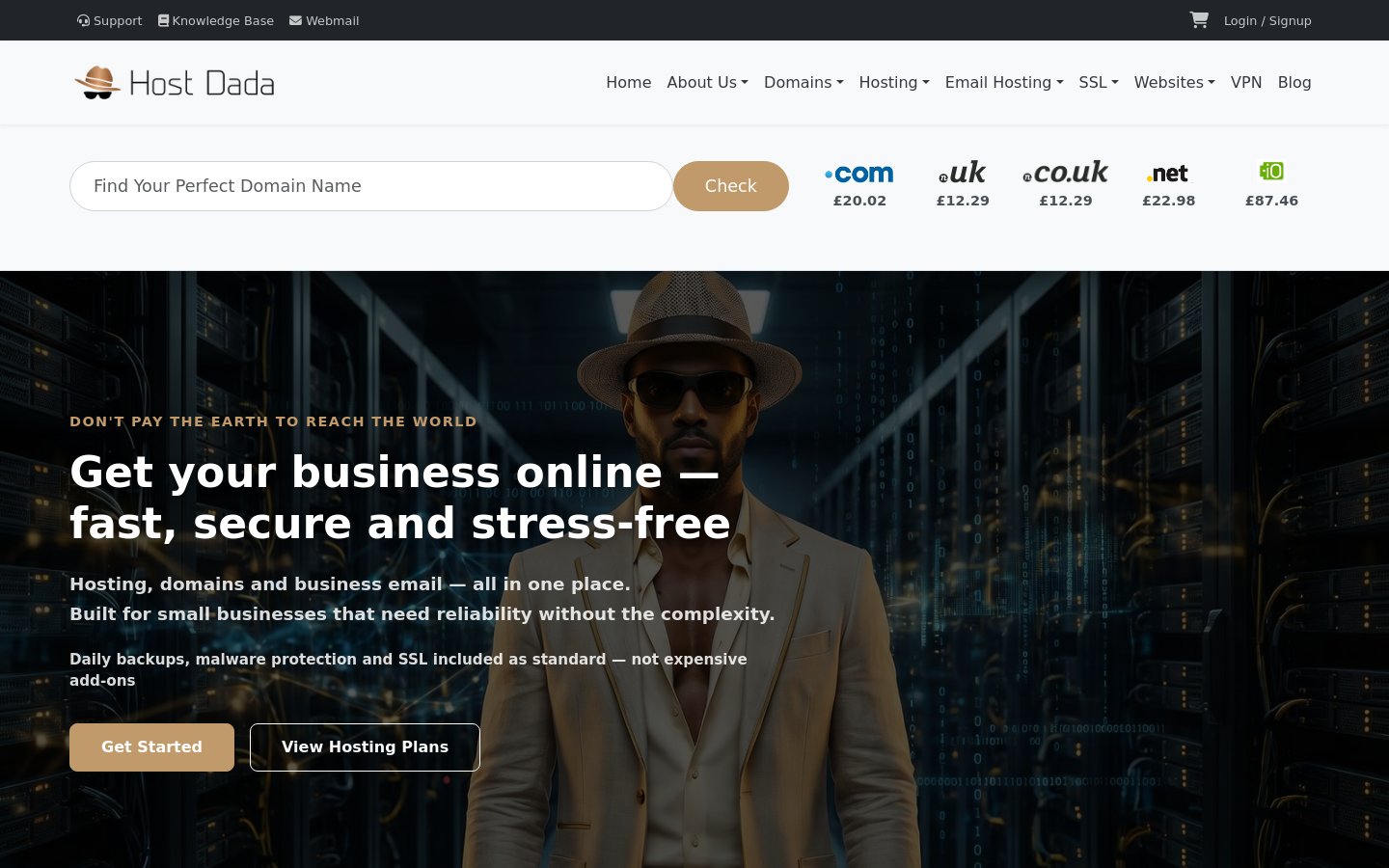
Host Dada – My UK Hosting & Domains Business, Rebuilt Around the Customer
Host Dada is my own hosting and domains business for small UK companies. I kept WHMCS for billing and fulfilment and built everything customers see in front of it: accurate domain search across hundreds of extensions, 409 search-friendly domain pages, a cart that hands orders back to WHMCS, single sign-on, first-party analytics and an AI phone receptionist.
Jump to a section
Built with
- Next.js
- React
- Bootstrap
- Node.js
- Express.js
- MongoDB
- Mongoose
- PHP
- WHMCS
- eNom
- Sharp
- Twilio
- OpenAI
- Nodemailer
- Nginx
At a glance
What it is
Host Dada, my own UK hosting and domains business, selling domains, web hosting, VPS, business email and SSL to small businesses
Where it came from
it began in 2009 as hosting for the clients of Kandeshop, my web design business, and grew into a brand of its own
What I built
the storefront and the platform around it: smart domain search, hundreds of search-friendly domain pages, a cart that hands orders to the billing system, single sign-on, a blog and analytics, and an AI phone receptionist
Status
trading, on a rebuilt Next.js site since July 2026
The business
Host Dada gives small businesses everything they need to get online in one place: a domain name, hosting for their website, business email and an SSL certificate. Daily backups, malware scanning and SSL are included as standard rather than sold as extras.
Domains
search, register and transfer, with prices for hundreds of extensions.
Hosting
Essential hosting for small business sites, WordPress hosting with staging, a higher-spec ProFlex Max plan, and unmanaged VPS servers built to order.
simple mailboxes, Exchange and Microsoft 365.
Websites
a drag-and-drop site builder, or a site built for you.
The problem
Like most hosting companies, Host Dada runs on WHMCS, the industry-standard system for billing, customer accounts and order fulfilment. WHMCS is good at that job. Its storefront is not where you'd want customers to start.
Hard to find
a stock hosting storefront gives search engines very little to rank. Every domain extension is a search term people use, and there was no page for any of them.
Wrong answers
WHMCS's built-in availability check gave unreliable results for many newer extensions such as .studio or .lol, telling customers a name was taken or free when it wasn't.
Two websites in one
customers moved between a marketing site and a separate client area, logging in twice along the way.
The decision wasn't "replace WHMCS". It was "keep what WHMCS does well, and build the part customers actually see".
The approach
Billing, invoices, customer accounts and provisioning stay in WHMCS, where they are proven and supported. In front of it sits a storefront I designed and built: fast, server-rendered and shaped around how small businesses buy. A thin API layer between the two is the only part that holds the WHMCS credentials.
What I built
Domain search that gives the right answer
For the business: customers see whether a name is free, accurately, across every extension, in one search.
Under the hood: a hybrid availability engine. Extensions with dependable WHOIS data, such as .com, .co.uk and .org, are checked through WHMCS. Everything else goes to the eNom registrar API in a single batched request, with a short cache so popular searches don't use up the API allowance. If eNom fails, each extension falls back to WHMCS, and results come back in the order the customer asked for them.
A page for every domain extension
For the business: every extension Host Dada sells has its own page that can be found in search.
Under the hood: 409 domain pages, each server-rendered with its own explanation, ideas for names and a search box, and the live price pulled from WHMCS. Pages refresh their prices on a timer, so a price change in WHMCS reaches the site without a rebuild.
A cart that hands over cleanly
For the business: customers build their whole order on the site, then pay through the billing system they'll use for renewals.
Under the hood: the cart holds domains (registrations or transfers, periods and add-ons) and hosting products with their billing cycles and options. At checkout it is passed to a custom WHMCS add-on, which rebuilds the order inside WHMCS for payment and fulfilment.
One login
For the business: customers sign in once and move straight into their account to manage services and invoices.
Under the hood: the site checks the customer's details against WHMCS and opens the client area with a single sign-on token. Logging out of the site logs them out of the client area too.
Content and insight
For the business: the team can publish articles and see what visitors do, without handing data to an ad network.
Under the hood: an admin with a Markdown blog and image handling, plus first-party analytics: privacy-friendly visitor counting with bot filtering, showing daily views, top pages, referrers and countries. The WHMCS client area reports into the same analytics.
An AI receptionist on the phone line
For the business: calls are answered, understood and routed to the right person, or captured as a message, even when nobody is free.
Under the hood: calls connect to an AI agent that finds out who's calling and what they need, and answers questions only from Host Dada's own sales pages and knowledge base. To pass a call on, it uses each staff member's working hours: the colleague hears a short spoken brief and presses a key to accept or decline. If nobody takes it, the caller leaves a message, which is emailed to the team, and the agent can open a support ticket in WHMCS. It never invents a member of staff.
The rebuild
The first version of the storefront was a React single-page app. It looked right, but search engines saw very little of it. In 2026 I moved it to Next.js so that the domain pages and blog are rendered on the server, while keeping the existing API layer, so the WHMCS integration didn't have to be rewritten. Old image addresses that other sites still linked to are redirected permanently, so nothing broke in the move. The new site has run on my own infrastructure since July 2026.
Products on the same brand
Host Dada is also home to two free tools I built and run: One-Time Secret, for sharing a password or file through a link that works once, and QR Code Generator, for dynamic QR codes that can be changed after printing.
Architecture
The storefront: Next.js and React, server-rendered, styled with Bootstrap.
The API: Node.js and Express, the only part that talks to WHMCS and eNom, with rate limiting, input validation and security headers.
The back office: WHMCS for billing, customer accounts, support and fulfilment, with a custom add-on receiving orders from the site.
Content and analytics: MongoDB.
The receptionist: a separate Node.js service using Twilio for calls and OpenAI for conversation and knowledge-base answers.
Technical stack
For readers interested in the technology:
Next.js 16 and React 19, Bootstrap 5, Node.js and Express, MongoDB with Mongoose, the WHMCS API with a custom PHP add-on, the eNom registrar API, Sharp for images, Twilio Programmable Voice, OpenAI, Nodemailer, and nginx.
Running on a platform that fights you?
Off-the-shelf systems are often right for the back office and wrong for the customer. I can build the part your customers see, and connect it properly to the systems you already rely on.